Fire Door Surveys

We have a dedicated nationwide team of inspectors, qualified and certified to carry out fire door surveys, who are experienced performing fire door surveys and inspections for all buildings.

Get your free quote

150+

5-star reviews

What is a fire door survey?

Fire doors are a robust fire protection measure which should be checked and maintained like any other life safety system in a building.

Read moreless

Fire doors help slow the spread of fire and smoke throughout a building, not only to protect lives, but also to protect the property and neighbouring buildings. This only applies, however, if they are correctly maintained in a working condition.

In addition to the implications from various design codes, standards and guidance documents, we strongly urge companies to have the condition of their fire doors periodically checked; failure to do so could dramatically increase the threat level should a fire occur.

Fire Door Surveys – Responsive. Efficient. Compliant.

Since the uncovering of drastic failings of passive fire protection in various building fires such as the Grenfell Tower disaster, the importance of suitable checks of passive fire protection has been significantly highlighted.

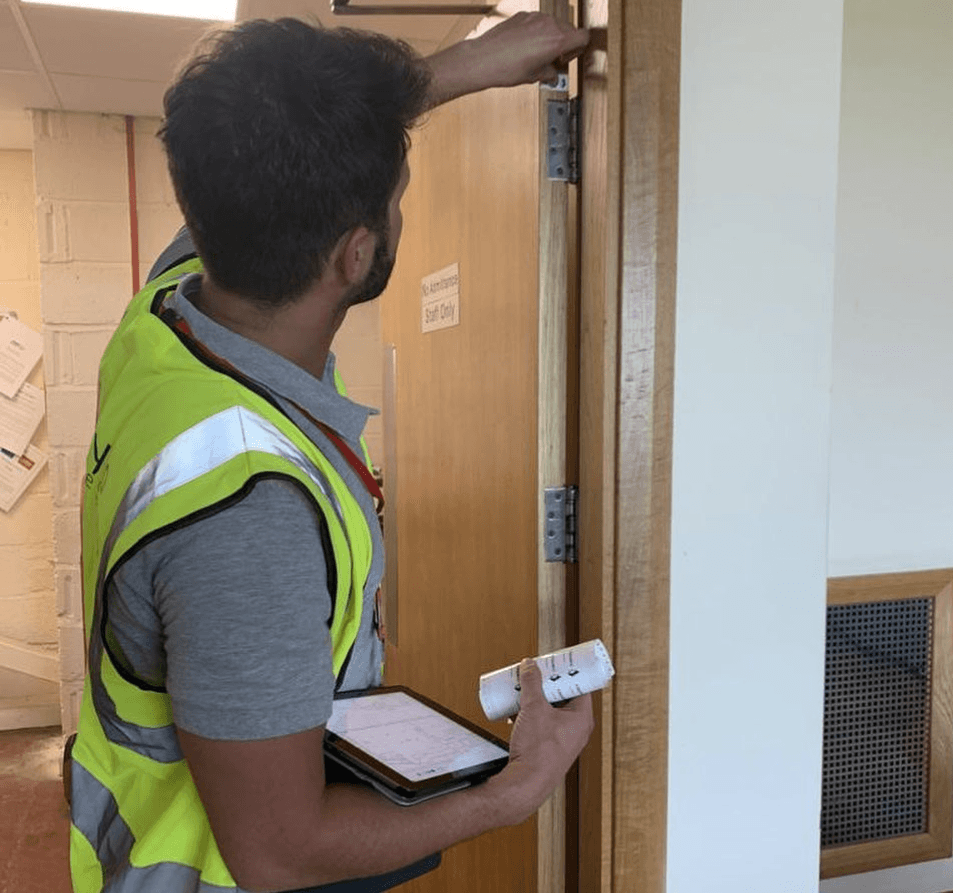
Our qualified and accredited surveyors will carry out a fire door survey for a property and perform a detailed check for all fire doors on-site to ensure they are safe, compliant and effective in order to protect occupants against the spread of smoke and flame in the event of a fire. The process comprises the utilisation of a mobile form whereby all aspects of a fire doorset are analysed and photographed.

The survey details we’ll record.

The following details are recorded:

  • Door ID and location
  • Survey type (certificated or nominal)
  • Door rating (FD20/30/60/120)
  • Door measurements/dimensions (inner and outer frame)
  • Door/frame material and type
  • Condition of frame, doorstop, hinges, lockset, glazing, seals, closer, structure, signage and gaps
  • Overall judgement (pass/fail)

All your digital Fire Door Inspections logs stored in one place

All information and documentation will then be uploaded to the easy-to-use web application. You will receive a login to a secure online portal where you can access your properties. For each of your properties, you can manage risks, make comments, and mark risks as actioned. You can also export risks to issue an excel spreadsheet to contractors for remedial quotations.

Read our Frequently Asked Questions below for more helpful information 

Get a quote

Need a quote? Or have a query?

Just fill in the form below and we’ll get straight back to you.

150+ 5 Star Reviews

FAQ's

  • Why do I need a fire door survey if I already know which doors need repairing?

    A full survey by a competent fire door inspector identifies the actual defects, confirms which doors need to provide fire resistance and explains how each issue should be addressed.

    Not every door in a building needs to be a fire door. We use the building’s fire strategy, compartmentation plans, fire risk assessment, available certification and the location and construction of each door to establish the appropriate survey scope. Where this information is unavailable, our inspector will use their knowledge and experience to identify likely fire doors and highlight any areas requiring clarification.

    The completed survey also provides an asset list of the doors inspected, helping you maintain and check the correct doors in future.

  • My fire doors were passed by Building Control. Are they still compliant?

    Building Control approval reflects the information and condition of the building at the relevant time. It does not guarantee that every fire door remains compliant throughout its life.

    Fire doors can deteriorate through everyday use, accidental damage, poor maintenance or unauthorised alterations. Hinges, seals, closers and other components may also have been replaced with unsuitable products. Regular checks and appropriate maintenance are therefore required even where the doors were previously accepted by Building Control.

  • Are fire door surveys mandatory, and how often should doors be inspected?

    Fire safety legislation requires the Responsible Person to ensure that fire doors are suitable, properly maintained and capable of performing as intended. A specialist survey may be needed where the condition or suitability of the doors is uncertain, defects have been identified or a fire risk assessment recommends further investigation.

    The appropriate inspection frequency depends on the building, its occupants, the use and condition of the doors and the fire risk assessment.

    In England, multi-occupied residential buildings with a top storey more than 11 metres above ground level require quarterly checks of communal fire doors and annual checks of flat entrance doors on a best-endeavours basis. These routine checks do not always require a specialist, but more detailed inspection should be arranged where concerns are found.

  • What do you check during a fire door survey?

    Our surveyors inspect the accessible components of each door assembly, including:

    • The door leaf and frame
    • Gaps around and beneath the door
    • Hinges and other ironmongery
    • Self-closing devices
    • Locks, latches and handles
    • Intumescent and smoke seals
    • Glazing and vision panels
    • Signage
    • Letter plates and air transfer grilles
    • Visible damage or unauthorised alterations
    • The operation and general condition of the door

    We also look for certification labels, plugs or other identifying marks and consider whether the door appears suitable for its location and intended purpose.

  • Do you need the original certificates to determine whether a door is a fire door?

    Original certification and installation records are helpful, but we recognise that they are not always available, particularly in older buildings.

    Our inspector will look for certification labels or plugs and assess the door’s construction, thickness, condition, seals, ironmongery and location. An older door that appears to have fire-resisting characteristics but has no readily available certification may be recorded as a nominal or notional fire door.

    The absence of a certificate does not automatically mean that every door must be replaced. However, where the required performance cannot be established with reasonable confidence, the report may recommend further investigation, repair or replacement.

  • Will you need access to every flat or room?

    Ideally, the surveyor should be able to inspect and operate each door from both sides. For flat entrance doors, we will work with you to select a suitable date and allow residents sufficient notice.

    Where access cannot be gained, the surveyor may complete a limited inspection from the accessible side and record the door as “No Access” or “Not Accessible”. A further visit may be needed before its full condition and operation can be confirmed.

    Finger guards and other coverings can conceal hinges, seals and door edges. Please arrange for these to be removed or released before our visit, as our surveyors do not remove or reinstate them.

  • What will I receive following the survey?

    You will receive a clear report containing an asset list of the doors inspected, their condition, photographs of relevant defects and recommendations for repair, further investigation or replacement.

    The report can be used to plan and prioritise remedial work and can be issued to competent contractors when obtaining quotations. It also creates a record that can support future checks and maintenance.

    A survey does not provide retrospective product or installation certificates for existing doors. Certification is normally supplied as part of an appropriate manufacturing and installation process.

  • Can defective fire doors be repaired, or will they need to be replaced?

    Many defects can be repaired where the door remains structurally sound and the proposed work is supported by the doorset manufacturer’s instructions or suitable evidence. This may include adjusting the door, replacing compatible seals or ironmongery, or correcting the self-closing action.

    Replacement may be recommended where the leaf or frame is seriously damaged, the core is exposed, the door is substantially distorted, multiple components are defective or a reliable and evidence-supported repair cannot be identified.

    After remedial work, a follow-up inspection may be appropriate – particularly where the contractor cannot provide suitable certification or substantial changes have been made to the door assembly.

  • How much does a fire door survey cost?

    The cost depends on factors including the number and type of doors, the size and location of the building, access arrangements and the level of inspection required.

    Our prices are competitive and there are no hidden costs. Once you provide the property address, an estimated number of fire doors and any available plans or previous reports, we can prepare an accurate quotation. As a VAT-registered company, VAT is charged on our services.

  • Do you carry out repairs, and what happens if further investigation is required?

    Pyro Fire provides independent fire door inspections, surveys and consultancy. We do not undertake the remedial work identified in our reports.

    Remedial work should be completed by a competent contractor. We recommend using a contractor certificated under an appropriate UKAS-accredited third-party scheme for fire door installation or maintenance.

    Because our surveys are normally non-destructive, some details may remain concealed, such as fire stopping behind the frame or protection around ironmongery. Where these details could affect performance, we may recommend targeted investigation. If the surrounding walls, floors or compartment lines are also uncertain, we may recommend a compartmentation survey because a fire door can only perform properly as part of a complete fire-resisting barrier.

    We do work with a number of approved partners, and we are able to recommend suitable contractors to you (depending on your location).

  • What Else Do I need to Know about Fire Door Surveys?

    The Crucial Role of Fire Door Surveys in Building Safety

    Fire door inspections are a fundamental aspect of maintaining a safe building environment. These inspections ensure that all fire doors within a property adhere to the latest fire safety standards and regulations, such as those outlined in the Regulatory Reform (Fire Safety) Order 2005. Regular fire door inspections are essential to prevent the spread of fire and smoke, safeguarding occupants and property.

    Ensuring Compliance Through Fire Door Surveys & Inspections

    Fire door inspections are integral to achieving and maintaining fire safety compliance. Certified inspectors assess each fire door to verify its fire resistance rating and overall functionality. These inspections include a thorough examination of the door’s materials, hardware compliance, and installation. Identifying and rectifying any non-compliance issues during these inspections is vital to maintaining the safety and integrity of the building.

    What to Expect During a Fire Door Inspection

    During a fire door inspection, a qualified inspector will evaluate the door, its door frame, and associated hardware, including hinges, locks, and closers. The inspection ensures that all components work together to provide effective fire compartmentalization. The findings are documented in a comprehensive fire door inspection report detailing any necessary corrective actions to bring the doors up to standard.

    The Importance of Ongoing Fire Door Maintenance

    Fire door inspections are not a one-time event but a critical part of ongoing fire door maintenance. Regular inspections help identify wear and tear, potential breaches, and other issues that could compromise a door’s effectiveness. This proactive approach ensures that fire doors meet the required safety standards over time, vital to a building’s overall fire safety strategy.

    Comprehensive Fire Door Surveys and Their Connection to Inspections

    While fire door inspections are crucial for maintaining ongoing compliance, fire door surveys offer a broader overview of the fire doors within a building. These surveys assess the suitability and condition of all fire doors, providing a detailed overview that informs subsequent inspections and maintenance efforts.

    The Relationship Between Fire Door Surveys and Inspections

    Fire door surveys are often conducted as part of a more extensive fire risk assessment and serve as a precursor to more detailed fire door inspections. Surveys provide an initial evaluation of all fire doors in a building, identifying which doors need further inspection or maintenance. This process ensures that every door meets the necessary fire safety standards and is ready for a thorough inspection.

    Documenting Findings Through Fire Door Inspection Reports

    Both fire door surveys and inspections culminate in detailed reports. The fire door inspection report is particularly crucial as it outlines the compliance status of each door, notes any non-compliance issues, and recommends specific corrective actions. These reports are essential for maintaining accurate records and demonstrating compliance during

    Utilising Certified Inspectors for Accurate Assessments

    Engaging certified inspectors for fire door surveys and inspections ensures that all evaluations are thorough and accurate. These professionals are knowledgeable about current building regulations and fire safety codes, enabling them to identify potential hazards and recommend appropriate actions. Their expertise is invaluable in maintaining the safety and compliance of fire doors across any building.

    Integrating Fire Door Inspections into Your Fire Safety Strategy

    Fire door inspections should be a central component of any fire safety strategy. By integrating these inspections with broader fire safety measures, building owners can ensure comprehensive protection against fire hazards.

    The Role of Inspections in a Fire Risk Assessment

    Fire door inspections are a vital element of a complete fire risk assessment. While the risk assessment covers the overall fire safety of a building, the inspection focuses specifically on the functionality and compliance of fire doors. Together, these assessments provide a comprehensive view of a building’s fire safety measures, ensuring that all potential risks are addressed.

    Implementing Corrective Actions Following Inspections

    After a fire door inspection, acting on the recommendations outlined in the inspection report is crucial. Whether the solution involves fire door replacement or straightforward repairs, timely corrective actions are essential to maintaining fire safety compliance. Regular follow-up inspections and ongoing fire door maintenance are also necessary to ensure fire doors remain effective over time.

    The Long-Term Benefits of Regular Fire Door Inspections

    Regular fire door inspections provide long-term benefits by ensuring that all fire doors within a building continue to meet safety standards. This proactive approach helps prevent potential disasters and ensures that the building remains compliant with all relevant fire safety regulations. Building owners can significantly reduce the risk of fire-related incidents by integrating these inspections into a broader fire safety strategy.

  • 0+ Clients
  • 0+ Fire doors inspected
  • 0+ Properties assessed
  • 0+ 5-star reviews

Our process

Inspect

Our survey inspectors will inspect your fire doors and gather the data for the report. We will affix ID labels, measure and inspect the doors, and take photographs of every individual issue.

Record

We compile a conditions table and action plan with recommendations and photographs. The data will be recorded in a way that is easy to understand, before being submitted for quality assurance. This will then be validated and published on your own online portal.

Manage

Once published, you can actively manage reports and action risks for your properties. You will be able to download and create PDF reports, search and export risks, and view photographs.  You can even send our report to a contractor for a remedial quotation.

Not sure where to start?

Speak to our team

Key accreditations

We recognise the importance of maintaining high levels of accreditation as a company, and as individuals. Our certifications include The Institute of Fire Safety Managers (IFSM), The Institution of Fire Engineers (IFE), and The Fire Industry Association (FIA). We’re third-party accredited by BAFE for Fire Risk Assessments, and our assessors are registered on the IFSM’s National Fire Risk Assessors Register.